Showing posts with label elementary. Show all posts

Friday, January 16, 2015

Ways to Say "Said"


Probably most that have been following along realize that writing isn't my kids' favorite thing to do. :-)  The last few weeks we've been doing some "fun" writing activities...not big writing assignments.  We'll get back into that, but for right now...let's get the fun back in!

They enjoy "Word Clouds".  The two older have dry erase boards and I have a word at the top for them to add to for a week or two.  It's great what they come up with!  
This word cloud was
"Other ways to say said."  :-)

When my printer is fixed...we'll print them and put them into a binder, for future use.


Thursday, January 8, 2015

Snowflake Angles!

My kids do a few minutes of Khan Academy Math, each day.  The other day my 4th grade was like, "I don't get decomposing angles."  I went and did my weekly check of their Khan Academy progress and sure enough it stated "struggling with decomposing angles".  I was like "huh?"  It really should have been a review.  But that's okay...it allowed me the chance to pull in some of the Pinterest ideas.  Ha!

That's a Schooling at Home Mom for you...I pin so so much, even if my kids are past that skill or haven't reached it.  It usually comes in handy, sometime along the road. 

 Excuse these snapshots (though they really aren't any different then the others I post, probably). However, I wasn't planning on typing up a blog post...
I wasn't really trying to get decent pics. 
 I take snapshots all day long so I remember some of what we've done. :-)  
We included T., the kinder, because he wasn't taking a nap and we are waiting for his Math1 curriculum materials to arrive.  :-)  He really enjoyed this and picked up the idea of angles really quickly!

You know what, I learned something today!  LOL  The K'Nex set has pieces to create right, acute and obtuse angles.  I was exclaiming over this realization and A., 6th grader, was like, "Well, yeah mom."  :-D  
Kinder actually used those 3 angles to help him with the snowflakes.  He did really really well!  He found angles that I didn't notice until he pointed them out!  Older kids used a protractor to check those really close angles they weren't sure about. Or, like the 4th grader, just use the protractor to see how many degrees all the angles are because that's just fun.  :-D
 
What's nice about this snowflake is that each child's snowflakes are going to look different because there are umpteen different options for angles!
A. decided to create a craft stick snowflake also.  We used it to look for right, acute, and obtuse for kinder.  

What I didn't get a picture of was our little dry erase board lesson on decomposing angles.  LOL  4th grader and I sat down and I used stickers on K'nex to show various angles and how we can figure out one angle if we know other angle measurements and how to combine smaller angles to make a bigger angle, and so on.   Really, he DID know this stuff.  The problem was he was stuck on the word "decompose".  LOL  That's him for ya!  Definitely something that happens frequently.  It was a fun review anyway!  He got back on and flew through the problems in Khan. 


Tuesday, January 6, 2015

Renaissance Artist: Pieter Bruegel

So, next on our timeline....
is Pieter Bruegel or Brueghel.  
This is thought to be a self-portrait.  Kind of scary, if you ask us!  :-D

I never heard of the artist myself, except for having used the K12 art curriculum for 3 years.  :-)  They introduce these pieces of art.

pics from Wikipedia

A stop at the library helped branch out our mini study.

We focused on Getting to Know the World's Greatest Artists: Pieter Bruegel.  However, I always get multiple because my kids love to browse through nonfiction books.  They seldom check them out on their own though, nonfiction books that is.

I decided we were going to do a bit with the "Hunters in the Snow" again.  Here is an art documentary that we watched part of.  I think this is the first art critic/documentary the boys have ever watched.  :-)  I recommend the clip for older kids as the younger ones probably just wouldn't be all that interested.  :-D  It's good for my boys to see things from different perspectives and learn to think more like a "critic".  It's something I'd like them to do more with....look at a piece of art work and discuss it.

I found an art lesson shared online regarding atmospheric perspective and we did it.  You can find it at ArTree.
K-2 art lesson power point final products

grades 3-6 art lesson power point final products

We also watched a couple clips just before the power point lesson, refreshing their memory about the Renaissance (Pieter Bruegel was a Renaissance Artist)

The Renaissance:  Was it  a Thing?
FYI:  this is VERY fast paced.  For older kids for sure.  We had already went through the Renaissance time period with both the 4th and 6th grader so it was more of a review.

and in the middle of it.  :-)

Arc of the Arts: Atmospheric Perspective
Almost TOO slow, after the last clip.  LOL


We also spent some time  on "Netherlands Proverbs".
An interesting piece of art, to say the least.  Ha!
It's been said that Bruegel painted this to go along with his typical theme of "absurdity, wickedness and foolishness of humans".  :-D  Someone so kindly put together a table with the 112 proverbs and idioms that could be identified in the piece of art.  :-)  It's found here.  Quite interesting, to say the least.  :-)  Just a FYI:  it could be be considered crude in some regards.  I skipped over a few of them.  :-D Got us talking about what a proverb was....a short saying, typically well-known, that teaches a lesson.  This conversation also brought up the book in the bible Proverbs.  A little definition I liked: 

A proverb was used to make the reader listen, think about, remember, and then practice.

Of course, we ended with an acronym with his name.  :-D  This time, however, I wrote his name up on the board and we added characteristics as we went along.  This was suppose to  allow us to do an abbreviated study of Bruegel as we were having an abbreviated school week.  Didn't happen though.  We worked into the next week.  Oops!  :-D  Oh well, quality vs. quantity, a wise person told me, is the key!  

Saturday, January 3, 2015

"Word Clouds" to Help with Writing


I find that my children often use the "same ol'" basic words in their writing.  So, I decided we are going to work together to come up with "word cloud" themes.  The first one they did was "movement".  What are different words we could use to describe movement.  They both had a dry erase board that they added to throughout the week and then we combined them into this piece of "artwork".  :-D  I'll be placing these into a binder so that they have an appealing resource to go back to when they are revising their writing.

Next up, other words for....

SAID

Thursday, December 25, 2014

Extension ideas for When the Root Children Wake Up by Audrey Wood

Read Write Think has a document with picture books that have well-developed settings.  You can find that document by clicking here.

I used this as a guideline for my kiddos, 4th and 6th grade, to go through and write about the characters, settings, and giving a short summary. Good practice for them and will help them in their journey in being stronger writers.

We read these books together as a group after the fact to discuss what they wrote down, as they need much practice in writing about books.  After reading, we also did an extension activity.  I found there were not a whole lot of ideas for these books online, like other more common books so I'll share the extension of this particular book with you.

When the Root Children Wake Up

This book was about the four seasons.  There is a character to represent each four seasons and children who had been asleep all winter wake up to enjoy spring, and then move through summer, fall and back to sleep.  

Before reading we brainstormed what we thought about when we see a color.  At first they started out with objects and then after a little talk about how certain seasons would fit into specific colors, they began to move into ideas/feelings colors may represent.  We talked about how illustrators often use a set of colors to portray an idea. 

 
At Web Design Depot we found this image that added to our conversation.

This image was stated to be at ZoeSoulSpa but is no longer available.  Moods/feelings are something we try to fit in as often as possible for the 4th grader, especially.

Another image that couldn't be found, supposedly at Educational Coloring Pages.  Kids liked this one because it was in a familiar format.


Google images are USUALLY a homeschooling mom's friend.  :-D  We can quickly BUT CAREFULLY search a topic and usually come up with a visual to help extend our conversations and thoughts.  My goal with discussing color is to bring their attention to how authors use color in their writing, especially to set a mood.  
An art project that we did to go along with this book was a Four Seasons Tree.  We got this idea from Arteascuola, a classroom blog. 
  

They used oil pastels and a toothpick to create the patterns, with exception of kinder who just used watercolor as this project was a bit above him.  We attempted doing watercolor-crayon resist but it really didn't suit for the paper we were using.  Regular construction paper, it probably would have worked.  Kiddos picked 2 or more colors to layer onto each section, per season, then used a toothpick (we did start with a paperclip but toothpick worked better) to create a pattern, if they wished.  

We "doodled" trees in our sketchbooks first.  This video helped us...
https://www.youtube.com/watch?v=1JmO6Cxr7ek

She went at a PERFECT speed for us.  :-)  Her calm voice helped diffuse any anxiety.  However, it starts out very light....the kids had a hard time seeing what she was doing at first, when we watched it as a group.  So, recommendation, watch it individually if you can and watch it completely through before starting over and sketching with her.


Thursday, December 18, 2014

A New Year....right around the corner!

Every holiday, every birthday, every year....
I never do what I want to do with them.  I'm always losing track of time and not realizing that I need to get started on planning if I want to do anything "special".  So, nothing gets done.  However, this year I'd like to make a goal to be more "on top of it" and maybe start some family traditions of our own.  :-)  

Created this document quick-like, with hopes it'll get me started on planning some things for the new year for our family....but if not, I'll at least have this done for the kids AND I to fill out.  :-D  You can click the link below to get this document WITHOUT the gray color.  Really, that's suppose to be white.  Normally when I save the .pdf as a .jpeg, it shows true colors.  Ah well, keeps me humble :-D
I chose not to put the year on, in case we want to use this document again.  The larger empty area at the bottom will be "decorated" with our names and 2015. 

I will be encouraging them to choose "small-doable" things and we are going to try to hold each other accountable for what we write down.  :-D  Should be interesting!

What are some traditions you have for your family?  I would love some ideas!

Monday, December 15, 2014

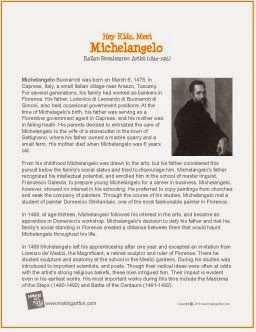
Famous Artists: Mini Study- Michelangelo

My kids LOVE timelines.  So, trying to work a few more into our day.  :-)  We also have a lot of fun doing projects/lessons together so here's a quick run over of what we started.

I came across this freebie at Practical Pages.  This is our guideline to some mini studies.  These are NOT taking a big part of our day.  We just touch on it a little bit most days of the week.

I'll use Michelangelo as our example of how I "touch" on these artists.


First, went to the library and picked up a few books.
Looked on internet for a video like we watched for Leonardo da Vinci...kids loved it! But, nope, couldn't find one I liked.  Oh, well. Back to the books.

Day 1) biography and search a word puzzle

These are challenging search a word puzzles because...there are NO words to find.  :-D  What  I mean, is that the children having to find "key words" from the biography and then look for them.  The first one we did, Leonardo da Vinci...was difficult.  Michelangelo...they did MUCH better.  So, 3rd grade and up, probably, younger if you are going to assist.
Day 2) Look through and discuss the artist's famous pieces of work.
We used books, internet art galleries and such.
Start project.

In this case we started the hands of Creation of Adam.
Yes, I had one kiddo that started balking at the nakedness in most of Michelangelo's works.  It surprised me a bit because really, we are pretty "matter of fact" about that type of thing.   Just the age, probably.  Anyway, we focused on the hands, fingers almost touching.
 -------------------------------------------------------------------------------
 I placed a large bulletin board across two chairs so they could lay upside down to paint.  Michelangelo spent 4 years standing on a scaffold looking up to paint the Sistine Chapel's ceiling.  I'd never get C. to do that so laying down was the next best.  :-D  With A.  I probably could have given him a ladder and attached his work to the ceiling.  ;-)  Anyway, C. lasted about 5 minutes and then asked if he could flip the board over.  Hey, he made it 5 minutes...that's better then not trying!

Day 3) Finish up the day before's project.
Below, C. is mixing up colors for his background.  It's about the only part of art he really likes...mixing his own colors.  :-D  For skin color I use the little saying, 
"Red, yellow, brown-white, that's how you mix skin tones right."  
Any combination of those colors will make a skin tone.  I always suggest starting with lightest colors first.
 

End Products:
4th grader who does not like art.  :-D  Didn't make enough of one color paint and then couldn't make the same color but it worked out nicely.  A year or two ago he would have given up or even ripped up his work.  He has made a lot of progress.  He was "bummed" but accepted it, even saying that it kind of looked like it was bringing focus to one of the hands.

6th grader's, more detail on hands.  He also painted the background laying on the ground like his hands.  He really enjoyed that.  :-)

Day 4) Project 2-Soap Sculptures
This was quite enjoyable, especially for 6th grader.  
Ivory soap is quite easy to work with.  Most of the time they used just the steak knife.  We went to the dollar store first and found bars for $1.  Went to Meijer and they had a 3pk for $1.29.  So in this case, check Meijer, or a similar store first.  I'm actually going to go out and get the large pack they had at Meijer to keep available in case the kids want to explore with it again.  :-)  There are little youtube clips about how to do it, but the jist of is to use the point of a knife to draw a simple shape and then cut/shave off until that shape is all that is left.  Use the flat side of knife to curve and smooth.

Day 5)  Artist's Name Acronym 
We actually did acronyms in writing and introduced it as a way to give information.  

(I've been taking pics with phone and every time I crop, I can't get the cropped image to upload...some day I'll get it figured out!)

This is the one from Leonardo da Vinci, from last week.  :-)  They wanted to do the same "picture as background" but we had to go legal sized paper for Michelangelo.  :-)
 

This has been awesome for the children...a way to learn about character traits but also organize information in an appealing way.  They love that we work together to make a final one in print shop, with pictures.  Soon, they'll be able to do that on their own!

Here's a site I found interesting.  POSITIVE adjectives in alphabetical order.  This is a great vocab builder for my kiddos!  
http://systemagicmotives.com/positiveadjectiveglossary.htm

I see there are others, I'll have to check them out.  :-)  I like the idea of keeping it "positive" though!


Monday, December 8, 2014

Inquiry Based Science---M & M explorations----fun stuff!

I've always felt that Inquiry Based Science is the way to go to get the most out of science.  We had gotten into the habit of "read the material-take the checkpoint" and science wasn't fun anymore.  Great info...but not applied or thought about after the fact and thus not retained for long.  So, I came across this freebie that is guiding us through some Inquiry Based Science lessons.  Wow!  We've had so many good discussions already! They've been actively using the scientific method, and coming up with their own questions and hypothesis and what variables could be changed also.  

Here's a fun looking freebie to help remember the steps in the Scientific Method:
There are so many poster freebies out there for this method!  Surely can't get bored!  Change is good, so I don't even laminate them...when one is needing to be replaced, because it's been used and abused, I print a different one.  :-D  You can get this one free at Teachers Pay Teachers.

The downfall, if one can call it that, is that there are so many directions we can take...we can easily spend an hour and a half in history and science...and still have more questions to explore.  Ha!  How do we progress through material but be able to touch on all those other concepts that come up?  We'll get it figured out.  :-)  At the moment I like being more relaxed and touching on many science concepts.   One way we are handling the "extra" questions is by writing our questions on post it notes and sticking them the wall so mom remembers.  :-D  We get to them as time allows.

You can find this book to download free at Inquiry In Action!  I'm very impressed with it!  We tweak it to work for my kiddos, K, 4th, and 6th grade, and we are slipping some Chem4Kids in between the first and the second lessons because dissolving brings up molecules and so on.  Good refresher for them and for myself too!  As a homeschooling mom, I never take the "I know it all" attitude because I surely don't.  I have to relearn or even plain ol' learn it the first time right along with them.  That has pros and cons.  Number 1) I can't always answer their questions but on the other side it makes us all have to dig a little deeper to find the answers and that is ALWAYS beneficial!  Learning to be a life-long learner.

Some pics from our first exploration
Our materials were
foam plates, package of M & Ms, colored pencils, room temperature water.  
We went from there!  It was so fun to put all that in front of them and ask them to come up with their own question about the material.  One of my goals is to get these kiddos back to "I wonder" thinkers ... the first step to problem solving... in my opinion.  
drawing out what they saw on their plates 


It was really neat to see the colors go above and below each other but not mix!  The kids were able to bring in their past knowledge, make new observations, try the experiment changing a variable.  So fun...yes, it's the way to go!  :-D

Variables they changed and explored:
water temperature
color of candy
type of candy
number of candies on a plate

I found that they asked many of the questions that the document suggested they would.  :-)
Problem we came across...those foam plates all raise up in the center...they are not flat. 
Problems are just fine...it ended up being a variable.  :-D

What's up next?
* Review on the states of matter
* Gummi bear explorations- physical change-all matter has volume-osmosis
*starting second lesson in Inquiry in Action document.

We've gotten a good start on our History project so they can be relatively independent for this next week, so the focus is on Science in the morning instead of history, I will have some happy kiddos!  Yeah!