Showing posts with label homeschooling. Show all posts

Wednesday, December 10, 2014

5 Minute Time Fillers for Schooling at Home Families (or for Anyone :-D)

5 minutes fillers, a bit of a lifesaver!

The life of a schooling at home family can be made VERY interesting when computers or programs start acting up.  Also, when you school multiple students, it seems like they all need you at the same time.  By year 3, I had it somewhat figured out what they could do independently, what they would need me for and planned their daily schedule accordingly.  But...there always seems to be some "wait time".  Wait time can equal goof off and distract your siblings time also.  :-D  One solution:  have a selection of profitable fillers ready for them to choose from while they are waiting for you.  Always good that you have a planned signal that they are waiting for you to help them.

Manipulative Ideas
Sandwich Bag of Legos
Task:  Create an item using ONLY the legos provided.  Be ready to share with the rest of the family when time permits.

Manual Sign Language
Task:  use the chart to sign through the alphabet.  Learn to spell your first name and work until you can sign it quickly and smoothly. Then move onto last name.  If time allows, learn your family members' names or practice your spelling words using sign language.


Language Arts Ideas
Free Reading
Search A Word/Cross Word Dollar Store Books
Task:  write your name at the top of one of the puzzles so that if you don't finish now, you can later. Work on the puzzle while time allows.

I also have themed ones that I place into binders, inside of page protectors and they use dry erase markers.  Then they can be reused.  Of course you can find these online too.
  
     A Kids Heart            Kids Puzzles and Games

Consider mazes, hidden pictures also!

Brainstorming
(I find that many students struggle with this so I often slip this kind of activity into our day.  I write brainstorming ideas on index cards and they write everything they can think of on that card, front and back.  Soon, I'll be posting a document with brainstorming ideas that you can print if you.  Keep and eye out for it!)


Task: spread the cards upside down and close your eyes.  Chose one card and write on it everything you can think of that comes to mind after you read the task.

Write a Letter
Task:  choose a family member to write a letter to.

Boggle

Task:  grab a piece of paper, give the boggle board a shake and write how many words you can find.

Fine motor-just for fun Ideas
Chopsticks
Task: use provided chopsticks and pom poms to practice picking up and moving them.  Can you create a shape or picture?


FingerWeaving
Task:  Grab a ball of yarn, start fingerweaving.  If you want to add onto it later, put a pencil through the loops when you need to stop.

Not exactly how it comes out for us...but it's the same process.  Here's a pic of my boys doing it.

Pipe Cleaners
Task:  Grab 5 pipecleaners, what can you make?  Be ready to share your creation with the rest of your family when time allows.

Playdough
Task:  grab a container or bag of playdough and a tray or mat.  Work with playdough until mom can get to you.

You can always make your own.  Here is my favorite home made cooked play dough recipe.
Cooked Homemade Playdough
1 C. flour
1/2 C. salt
2 tsp. cream of tartar
1 C. water
1 tsp. vegetable oil
food coloring (or I often use a packet of kool-aid.  Inexpensive, bold colors and a lovely smell.  :-))

Paper Airplanes
Task: Fold various types of airplanes, using scrap paper.  Find an area which would not be distracting to others and test your airplane.  Change the variables: type of paper, size of paper, folds, etc.

Art Ideas
Chalk Art
Task:  create a winter picture using white chalk on black construction paper.  (When done, have mom help you spray with aersol can of hairspray so it doesn't smudge as easy.)

Doodle
(I bought small sketch books for each of my students).
Task:  Doodle or sketch in your sketchbook.

Oil Pastels


Task:  Grab a package of pastels and a black or white piece of construction paper.  Enjoy exploring.

AntiColoring Sheets
Task:  Choose a printed coloring sheet to color using colored pencils.

You can find them online or you can purchase books also.
 
http://www.geometrip.com/free/coloring/designs/rectangles/page2.html
I actually do not find many when I google "anticoloring" mainly because that' is probably a copyrighted product.  So, when searching online, google "design coloring".

Math Ideas

Math Facts
Task:  set timer for 5 minutes, fill in as many multiplication fact answers as possible on chart.
There are many blank charts available but here is one for you.  You can find this one....and several other multiplication charts at Math-Salamander


Number Pattern Task Cards
(On index cards write a beginning of a number pattern.)
Task:  Grab a piece of paper and a task card.  Begin by writing down the initial pattern and then complete it with the next 5 numbers.  Finish that task card by writing out the pattern rule underneath the numbers.  Continue onto next card.  

examples:
2, 4, 6, 8,    count by 2s 
3, 8, 18,  38     add 1, multiply by 2


Also, there are a lot of logic/brain teaser sheets available online or you can purchase a book of them.  These make GREAT time fillers!
My kids love these kinds of brain teasers :-)  
http://printable.my3gb.com/printable-brain-teasers.html

Brain Teaser Examples here:
http://www.netplaces.com/kids-riddles-brain-teasers/puzzle-answers/

Logic puzzle example
http://www.squiglysplayhouse.com/PencilPuzzles/More/AnimalLogicPuzzle.html

Let your imagination go!  If you have your own time fillers that are a success, please share the in comments!


Monday, December 8, 2014

Inquiry Based Science---M & M explorations----fun stuff!

I've always felt that Inquiry Based Science is the way to go to get the most out of science.  We had gotten into the habit of "read the material-take the checkpoint" and science wasn't fun anymore.  Great info...but not applied or thought about after the fact and thus not retained for long.  So, I came across this freebie that is guiding us through some Inquiry Based Science lessons.  Wow!  We've had so many good discussions already! They've been actively using the scientific method, and coming up with their own questions and hypothesis and what variables could be changed also.  

Here's a fun looking freebie to help remember the steps in the Scientific Method:
There are so many poster freebies out there for this method!  Surely can't get bored!  Change is good, so I don't even laminate them...when one is needing to be replaced, because it's been used and abused, I print a different one.  :-D  You can get this one free at Teachers Pay Teachers.

The downfall, if one can call it that, is that there are so many directions we can take...we can easily spend an hour and a half in history and science...and still have more questions to explore.  Ha!  How do we progress through material but be able to touch on all those other concepts that come up?  We'll get it figured out.  :-)  At the moment I like being more relaxed and touching on many science concepts.   One way we are handling the "extra" questions is by writing our questions on post it notes and sticking them the wall so mom remembers.  :-D  We get to them as time allows.

You can find this book to download free at Inquiry In Action!  I'm very impressed with it!  We tweak it to work for my kiddos, K, 4th, and 6th grade, and we are slipping some Chem4Kids in between the first and the second lessons because dissolving brings up molecules and so on.  Good refresher for them and for myself too!  As a homeschooling mom, I never take the "I know it all" attitude because I surely don't.  I have to relearn or even plain ol' learn it the first time right along with them.  That has pros and cons.  Number 1) I can't always answer their questions but on the other side it makes us all have to dig a little deeper to find the answers and that is ALWAYS beneficial!  Learning to be a life-long learner.

Some pics from our first exploration
Our materials were
foam plates, package of M & Ms, colored pencils, room temperature water.  
We went from there!  It was so fun to put all that in front of them and ask them to come up with their own question about the material.  One of my goals is to get these kiddos back to "I wonder" thinkers ... the first step to problem solving... in my opinion.  
drawing out what they saw on their plates 


It was really neat to see the colors go above and below each other but not mix!  The kids were able to bring in their past knowledge, make new observations, try the experiment changing a variable.  So fun...yes, it's the way to go!  :-D

Variables they changed and explored:
water temperature
color of candy
type of candy
number of candies on a plate

I found that they asked many of the questions that the document suggested they would.  :-)
Problem we came across...those foam plates all raise up in the center...they are not flat. 
Problems are just fine...it ended up being a variable.  :-D

What's up next?
* Review on the states of matter
* Gummi bear explorations- physical change-all matter has volume-osmosis
*starting second lesson in Inquiry in Action document.

We've gotten a good start on our History project so they can be relatively independent for this next week, so the focus is on Science in the morning instead of history, I will have some happy kiddos!  Yeah!


Monday, August 19, 2013

Spelling!

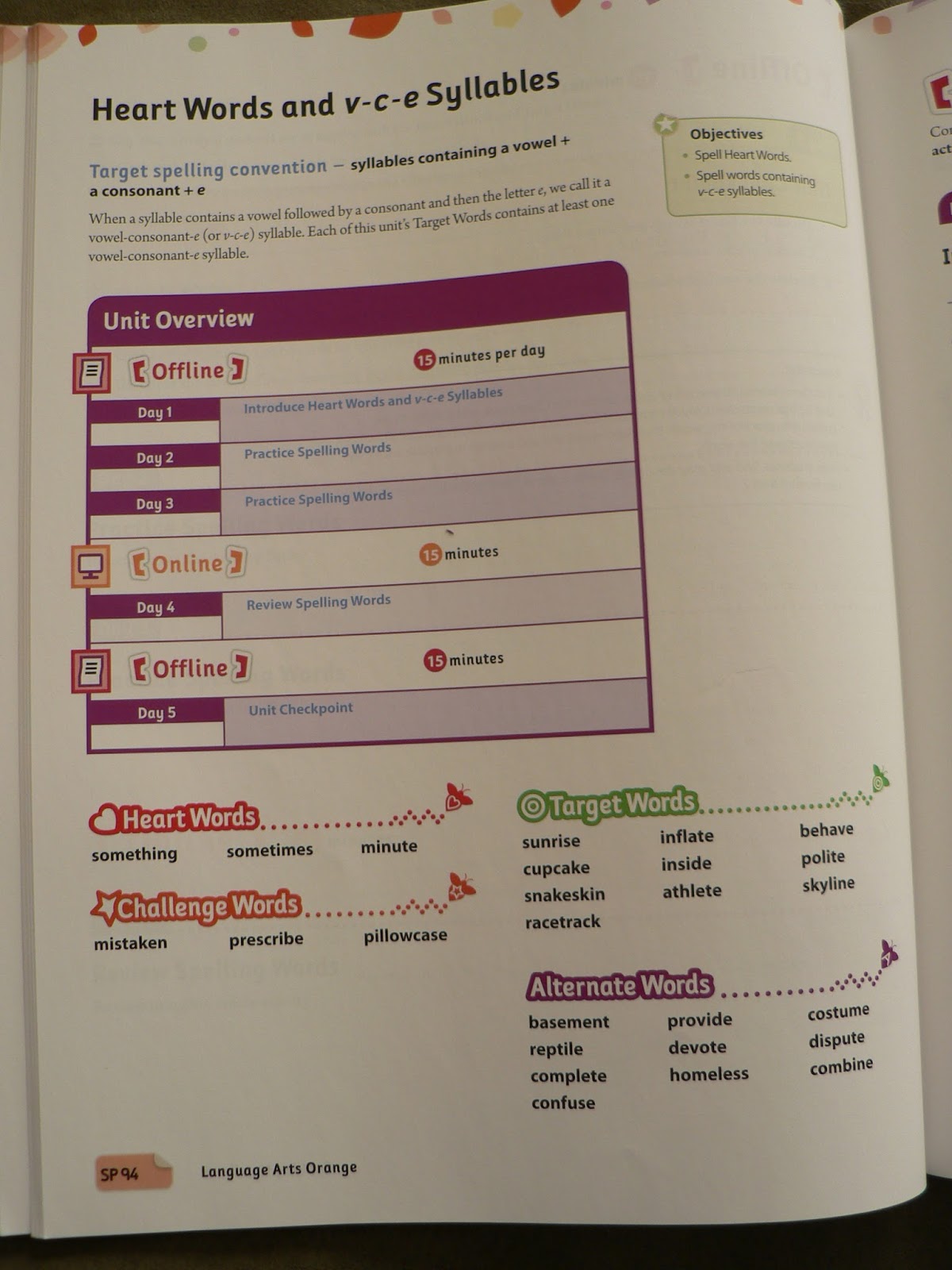
This post is specific to K12 curriculum for Grade 2.  However, the information can be used to spark ideas for any grade or curriculum spelling.

Tip:  Last year I really didn’t read all the details very well with spelling for 1st grade.  I thought it was pretty self-explanatory.  Needless to say, I didn’t get it figured out until MUCH later that they didn’t start spelling until 2nd semester.  Their focus is sight words for 1st semester.  Just an FYI if you haven’t gotten that far with your 1st grader’s materials.  When my 1st grader starts her spelling words, we’ll do this similar process for her also. 


Spelling Word Cards
Last year we took the suggestion of writing the words on index cards.  Definitely will do that again at all grade levels.  Partly into the year, I got smart and started writing the grade and unit number on the back of the cards.  So now I have Heart Words (sight words) and Target words (the words that follow the “rule” being taught) written out and ready to go, by unit…separated into index card holders, 1st semester and 2nd semester.  
--------------------------------------------------------------------
Last year, I just didn’t feel very organized or creative with Spelling.  All the “cute” or "looks fun" ideas really just took too long for them to do.  Our time is precious and I really needed quick and easy spelling practice.  And to be truthful, spelling came very easy for both 2nd graders last year and they often took the route of just looking at the spelling word cards “saying, spelling, saying” them.  However, this year, I know the 2nd grader has a little more difficulty with learning spelling words so I want an organized way of handling it.  This is the sheet that is printed off for him.


If this is something that works for you, you can download it here.  2 pages...with or without the 2nd grade label.  If you would like something tweaked on this page to meet your non-K12 student, feel free to send me a message.  I’d be glad to tweak it for you and email you the new document.
-----------------------------------------------------------------------------
So, what was I going for?  Short and sweet.   Something that after about a month into school, he will no longer need my instructions on what to do with his spelling words.  Variety?  How we build and what we use for sensory materials will vary so he’ll get a bit of variety.  ABC order…this is because I assumed the kiddos knew this last year and found out that most had difficulty with alphabetizing…even with an ABC chart in front of them.  So, this year…all kiddos will be practicing this weekly with their spelling word cards. 
Something we did last year that they thought was awesome (and me too…less tedious work!) was that if they passed their online review with no more than 2 wrong…they didn’t have to take their test on Friday.  It definitely motivated them to learn them.  Who wants to do spelling on “Free Friday?!”  It only happened on a handful of occasions and definitely spread out in between.  If they did not pass their spelling test…they had to practice them on the weekend and retake it on Monday.  MVCA is a "mastery required" program.  What that means is that all checkpoints, etc must be passed at 80%.

FYI:  For K12 online schools, every unit has a spelling review game online…if you are not a K12 family…you can use something like Spelling City as your online review.
-------------------------------------------------------------------------
A few ideas to get you started...

Sensory Tray Ideas
*  shaving cream
* hair gel
* fingerpaint
* salt (especially fun with rainbow paper underneath)
* thin layer of flour
* cornmeal
* sand (craft sand works best)
* playdough and letter stampers

--------------------------------------------------------------

Build and Write
* rubber letter stamps
* letter beads on pipe cleaner
* alphabet mini stickers
* letter cubes
* newspaper or commercial paper letters
* magnetic letters
* letter tiles
* foam letters

------------------------------------------------------------------------
What on earth is "Spelling Word Introduction"?
 They have Heart Words (sight words), Target Words, Alternative Words and Challenge Words.  It really depends on the student how many words you use.  I decided early on our focus would be Heart Words and Target Words.  Preferably at 1st and 2nd grade level, I didn't really want more than 10.  

On Mondays, every child sits with me and goes through their words.  I love the "Target" rule of each unit.  Actively teaching them this rules helps them learn those spelling words more quickly!  And, of course, it helps them with spelling in their general writing.  Sitting with them helps us decide just what words they'll be working with that week.

I usually let them try to spell the word on the dry-erase board.  Depending on the child, I would have them verbally spell it and I would write it on the board so they could see it.  We focus on the spelling rule...finding it in every word and so on.  Then we sorted the spelling words...

I already know these.
These are a little more difficult.

If they hesitated in spelling, it went into the "little more difficult" pile.  That gave us our main chunk of spelling words for the week.  Sometimes I pulled in the alternate or challenge words, sometimes I didn't.  

-------------------------------------------------------------
I'd love to hear how others go about helping their kiddos learn their words!  3rd grade and up have an activity book to go with their words.  My 4th grader last year did NOT like it at all...but mom did. ☺  Yes, it took a little longer time to get through spelling but it went beyond rote memorization.  And as long as he used the "say, spell, say" technique every time he wrote the word down for an answer...he passed the tests just fine.  When he didn't...no, he didn't do well on his tests.  The older kiddos are more than welcome to use the letter builders and sensory tray that is available that day/week if they wish to ALONG with their activity book.  ☺


Tuesday, November 27, 2012

Magnetism

This week, in Science2, the children were learning about magnetism.  Today, all the kids were involved. 
 
 This "all wanting to be involved" is one thing I struggle with here with our schooling at home.  Most of the children want to do the other children's science, art, and history lessons...sometimes even literature.  So how do you level that out?  Any suggestions?  One side of me really wants to allow that.  Most off these kiddos hasn't had the "background" that some of the K12 curriculum already assumes they do.  Besides that, they learn so much from each other in group lessons (even if it's just learning patience/sharing).  The conversations that we have during the lessons and what I hear after the lessons are lovely!  But...if I let them all join in each other's lessons...then they don't get their own lessons done in timely manners.  So, we're still working on a balance.  Today I decided, "whatever...we'll catch their lessons up somewhere else" and then of course I'll start worrying about when on earth but...it'll get smoothed out somewhere along the way!  Today we did group multiplication (3rd math), group magnetism (2nd science), group volcano (2nd literature).  The 2nd grade curriculum is super!  The first grader here is one lucky boy!  He may not understand every aspect of our group lessons but boy oh boy...he's getting quite a foundation for learning! 
 
So back to the topic of magnetism. 
I could only find them on the World Book site and they cost $295...so we'll continue checking them out from the library.  We LOVE Bay County Library System!  :-D
Here is a series of books by World Book that I passed up umpteen times because they really didn't appeal to me all that much but broke down on the Magnetism book because it touched on every objective that our week long science2 unit covered.  The kids absolutely loved this cartoon style book!  I will be going back to check them out again at the library, this time being a little more open minded about the series. We'll be moving onto the Sound unit and look at that!  There's a "sound" book.  I'm curious if it will cover as much as the Magnetism book did!  Anyway, I tweaked our plans a bit and we did multiple "lessons" in a day and finished up the unit with them acing the unit assessment...all with using this book vs. the computer lesson and doing some hands-on explorations.  Lovely!  That frees up time during the rest of this week to do other subjects.  Other Schooling at Home and Homeschooling families will definitely understand!  :-)
 
Below is one of many explorations we did during the last couple days and it was so interesting to the kiddos!  Very simple...if you haven't done it yet...please do!
We were exploring this idea that the Earth is a giant magnet and how that allows a compass to work.  So we created a compass with a bowl of water, portion of a plastic cup and a magnet with N/S poles labeled.  FYI:  be sure you have your other magnets put some distance away.  :-P  No matter where they move the cup with the magnet it will ALWAYS turn back to the N, and relatively quickly also!  (Except when the 3 year old slipped the magnet wand near the bowl.  LOL)  They loved this very simple experiment and it helped them think "outside of the box".  I don't know about you all but getting the kids to express "I wonder" statements is really hard.  All of them.  Typically I don't see that among homeschooling families but I do see it among many brick and mortar schooled families.  Interesting little observation there. In our situation, there was one teacher that gained my respect immensely but after leaving that classroom...the outside the box thinking/I wonder thinking was gone within a few months of being with the next year's teacher.  Isn't that sad?  There are some lovely teachers out there but I find that those are few and far between and I don't place the blame solely on them.  I do feel a big portion of it should be placed on the higher ups who think they know what's best in the education realm...and in reality...they really don't.  The actual teachers are paying the price...which in turn is causing the students to pay a big price also.  Ah!  We're grateful for options for education!  I'll get off my soapbox now.  Just to set things straight...I'm not against brick and mortar schooling.  It definitly has it's place.  If it comes down to it, I wouldn't hesitate to put them back in one.  However, my feelings on homeschooling/schooling at home have changed immensely within the last 3 months.  There are pros and cons to both, absolutely.  Right now, though it takes a lot of work on my part and the children's part...we love what we are doing.  (And whoever said that schooling at home/online schooling is more like independent study and is not remotely similar to homeschooling...is incorrect...yes, I've heard that.  :-O  Definitely not independent study and the parent/learning coach is directly involved.)
 
Shout out for K12/MVCA!  Awesome curriculum/awesome staff-support! 

Wednesday, October 31, 2012

A Peek At Our Morning

A side note: 
Well, no followers for this blog.  Ha!  The funny thing is that I have a ton of pageviews.  Very interesting...and not all that surprising.  :-)  Number one reason...Pinterest.   I've fallen for it too!  I very seldom follow blogs anymore.   Those that I am "following" I very seldom get to anymore.  I 'follow' the boards of the owner of the blogs I'd typically follow.  Second reason is that I'm not providing a bunch of free printables, but that's besides the point.  This blog is mainly way to keep track of what we try, what works, what doesn't, etc, and answer some questions that people connected to me have.  Some day I'd like to get more into the activity making...it's a hobby I've enjoyed but right now...no time!  So we'll use this blog as a "record" for now.


I'd like to share a bit my feelings, as of this moment, of "schooling at home" and a bit of our schedule as I know there are some that wonder how one earth I do what I'm doing.
 
Recap: 
A relatively small house + 6 kids ranging from 3 years old to 9 years old=necessity to be pretty structured and organized.  :-) 
 
We have a  more flexibility than a brick and mortar school but not as much flexibility of a true homeschooling family. 
 
I love the peace that I can get from the curriculum being provided for me and the support of many, very helpful, teachers. 

I love that the curriculum they provide tends to connect from one subject to the next...and that they touch on each subject in each grade so we can often converse about a topic and everyone knows at least a little of what we are talking about!

I love that my kids now love history!  We are learning so much in history! 
 
I love the fact that the children are learning so much from each other and that we have a bit of flexibility in how long we spend on one topic vs. another topic.  If a child is struggling in an area, we can take a break from it.  Maybe they just aren't ready to take on that concept...we just go back to it at a later date.
 
I love that the children do not have to wait for the rest of the class if they have mastered a topic. 
 
I love that children are more than welcome to sit in on another child's lesson(time permitting)!  History, Art, Social Studies, Science is often the subjects they like to sit in on.
 
I love that throughout the day I hear about "what I learned" vs. "I don't know" when I asked about it while they were in attendance at a brick and mortar school.  Also, because I'm directly in the center of their education, we can apply the material immediately in every day circumstances.
 
I love that we only have to do the basic practice sheets if that's all we need and not have a bunch of repeated/unmeaningful/time filler pages to do. 
 
I love that I can change a worksheet into a hands-on activity and not have to have the actual worksheet because I'm right there with them seeing if they understand or not. 
 
I love that each of the grades get a good background of history... their science is much more hands-on and for the first time they have a formal art program! 
 
I love that 2 of my students, and eventually all of them, have the option of learning Spanish at a young age (when they SHOULD be learning a language). 
 
I love that the children are excited about their learning and they connect it with whatever they are doing.  This is a first!
 
I love how much I'm growing as a mom and teacher.  I'm still learning patience. After working with kids for approx. 15 years, I'm still learning patience.  It is not a natural thing for me...definitely learned.  So as I'm learning patience, the kids are learning to be patient with me also. :-)


On the downside are the typical "homeschooling" cons.  At this time the pros definitely outweigh the cons.  We chose this program for the basic education it provides, individualization, accountability, etc...not because of gym, music, and the social aspect of school. 
 
We understand that gym and music is a lovely chance for many a student...and may be their only chance of participation of that type of thing.  However, when a family understands the benefits of gym/music, but still choose homeschooling or schooling at home, they can make adjustments in their child's overall education as needed.  Place their children in music lessons, sports, join a gym etc.  One can also teach the basics of music...but more importantly teach music appreciation.  One can also teach the basics of physical education and health and more importantly show by example the importance of healthy eating and taking care of one's body.  Let's be honest here...what do you remember from gym...or music for that matter?  All stuff that we can do at home.  Yes, it's nice to have a large indoor space in which we can play group games and etc...but it's not necessary...years ago in a one room school house, they surely didn't have organized gym/health and music.  It was incorporated in the day and plenty of time was spent outdoors...either at school or at home...chores or play.  Who was healthier?  We would have to admit that generations before us were much more healthy.  So as long as we are doing our part in fulfilling the basics of those electives...all will be well.  :-)
So, to the schedule...
We've explored with many different ways of doing our schooling...we'll continue exploring as the children grow and develop.  At this point, my oldest, 4th grade usually does his work that can be done independently in his bedroom. This keeps distractions down to the minimal...and truthfully, he wants to do what every one else is doing and so though I would like for him to do that...that would mean that I'd be having school after school every day just to get his own work done! (And most days we already do!-we're almost caught up and so his daily work load will start to lessen.)  The other children are in the kitchen with me...doing the 'around the table' approach.  Is it working?  You bet!  I thought there would be quite a bit of distraction for each other but there really isn't that much.  The benefit...they talk amongst each other (conversational skills that aren't often taking place in brick and mortar) and they are learning patience!  I really do only have 2 sets of ears, 2 sets of hands, 2 sets of eyes.   :-)  So yes, they do learn patience and they learn independence because more often than not if they reread what they are questioning...they will figure it out on their own...while they are waiting for me...or even better, they help each other! 
 My job isn't over when school is over...just like a typical teacher.  But, my planning is a little different than a typical teacher.  :-)  After school is out I'm correcting papers, answer input, and reading and preparing lessons, prepping "extra" activities,  and the biggest job is to coordinate who does what when.   
 
This is our general schedule, subject to change.
8:00-8:30   Group Lesson 
 
8:30-9:00  3 year old:  tray work
                  1st grader: PhonicsWorks (the activities that require me)
                  2nd graders:  online portion of math-by the time they are done I'm usually done with
                                       1st graders and can implement math learning and provide help as needed.
                  3rd and 4th graders:  independent work (typically spelling/literature/language arts)
 
9:00-10:00  3 year old:  tray work 
                  1st grader: "independent work" (not always completely independent but doesn't require
                                    me to sit right next to him.)  Sight words, spelling words, penmanship, reading,
                                    and math-as soon as I am available to assist.
                  2nd graders:  vocabulary (online), spelling, HWT's (printing review, beginning cursive)
                  3rd/4th graders:  continuing in what they are working on in language arts/literature, also
                                     writing, finish art lesson, cursive, etc.  I'm available for them at this time if
                                     they need assistance.  Typically they need assistance in math and writing.
 
10:00-10:30  Snack/"recess" 
                    About 2x's a week we do organized games to teach basic physical education components.
 
10:30-11:15  3 year old:  educational DVD, free play, and/or Great-Grandma play :-) 
                      1st grader:  art project, language arts (after I'm completed with 2nd graders), finish up 
                                         or "extra" activities, slip in science or art. 
                      2nd graders:  Literature (with me, as soon as we come in from outside), writing skills,
                                          and finish up or 'extra' activities. 
                      3rd and 4th:  math and writing, science/history/social studies
 
11:15-11:40   Free play and finish up activities.  If someone is needing extra help or had a hard time
                      staying focused...we use this time to "catch up".  I also slip an extra science, history, or
                      art with the kiddos every once in awhile...but I find that they need to know they have
                      this "free time".
 
11:40-12:00  A very basic bible lesson.  We do a memory verse, learn songs, and read a story
                     throughout the week.  At the moment, our actual formal music lessons have been put on
                     the back burner.  As you can see, our morning is pretty full.  So, at this time, I have my
                     own children enrolled in lessons and do encourage the other families to do the same and
                     in the meantime, I slip in a bit of "music" during this time.  But more importantly...we
                     are working on music appreciation at this time.  Off and on during the morning we listen
                     to various types of music and discuss it informally.
-----------------------------------------------------------------------------------------------------------
*  1st grader does science, history, and formal art lesson (usually minus the project...he usually does it the next day during the morning) in the afternoons that he is here.
 
*  Group lessons vary.  We typically have done History2 since all the children haven't had the opportunity to learn  K12's history curriculum.  All of it is new!  So we are building a foundation...it's awesome!  We also slip in Social Studies at this time.  So far they are on the same general topic guideline...just go into the material a little deeper the older they are.   On Tuesdays, most of our class connects are on this day so we usually do Draw.Write.Now on this day so that they can get started into their work right at 8:30A.  This week we did an Art1 lesson together because I knew it would be interesting and fun for all.  They loved it!  We learned about Wassily Kandisky... and we created art along with fast and slow instrumental/classical music.  In all art lessons, all students have the opportunity to use the materials that are out for a specific lesson...even if it isn't their lesson.  They love this!
 
*  Class connects.  These are once a week running from 30-60 minutes.  This is a time for them to meet with their teacher and classmates, work on some concept that the children may be having difficulty with.  There are also, extra class connects for students who need more assistance in reading, writing, and math.                      
 
*  We do monthly conferences with learning coach (me), assigned teacher, and student.
 
*  One struggle I have is slipping in science/history (both require me completely) for 3rd grade.  We have slipped it in rather well in our morning with 2nd grade and 4th grade does his in the afternoons with me.  So we're working on finding out how we can slip that in. 
 
*  One afternoon a week I have the children into the afternoon.  One child has a class connect in the afternoon...we had been doing group art then but I don't want the child missing out on that so we are working on independent work for 2nd graders and I'm focusing on doing a history and science lesson for 3rd grader on this afternoon.  We still need to slip in another history and science lesson during the week though.  :-)
-----------------------------------------------------------------------------------------------
Another concern I had and I know others had was just how much of the time are the children sitting in front of the computer since this is a "visual" academy we are enrolled in.  Surprisingly, not much!
Left:  note the phone...E. is taking his DIBELS test with his assigned teacher.
Right:  C. is doing a math lesson at the computer.  They often start with an intro lesson and then move to the table for hands-on practice.

 1st grader:  average of 5-10 minutes for math, 15 minutes for Study Island, class connects-1-2x's a week.  I do allow use of technology to help him practice math and sight words but really, it doesn't add to much.  Science, history, social studies, art are all "online" but I implement them so they are not sitting in front of the screen.  Yesterday and today...he didn't use the computer at all.  :-)
 
2nd graders:  5-10 minutes for vocabulary, 10-15 minutes for math, 15-20 min. for Study Island, 15-20 minutes for Spanish and 30 minutes once a week for class connect.  Of all my students, they are probably on the computer the most.  But really, 1 hour out of 6 hours isn't bad at all.  :-)  Between the movies they watched in school (educational or unmeaningful/uneducational) last year in 1st grade, computer games they played at school during and outside of computer lab, and whatever DVD/TV/video games they were getting at home after school......well, I'll take the 1:6 ratio.  :-)
 
3rd grader:  20-30 minutes for math, 15-20 for Study Island, 15-20 min. with an online reading program- again, about an hour for 5-6 hours (the 2nd and 3rd grader do about one hour of "homework" after they leave me.)
 
4th Grader:  30 minutes for math, 15-20 for Study Island...a bit more if he does science, art, social studies, history independently but that doesn't happen much.
 
So the concern about spending all day in front of the computer...it's gone.  :-P
---------------------------------------------------------------------------------------------------


 Here are "my kiddos"...love 'em!